Tracecat logo

Tracecat

Security Information and Event Mgmt. (SIEM)

Open Source
Free Tier
E
Enterprise
E
Enterprise
Self-hosted
OpenMSP Score
19
6
Reddit Impact Score
Github Score
40M
3KStars
385Forks
5KCommits
GNU Affero General Public License v3.0License
Jul 6, 2026Last commit
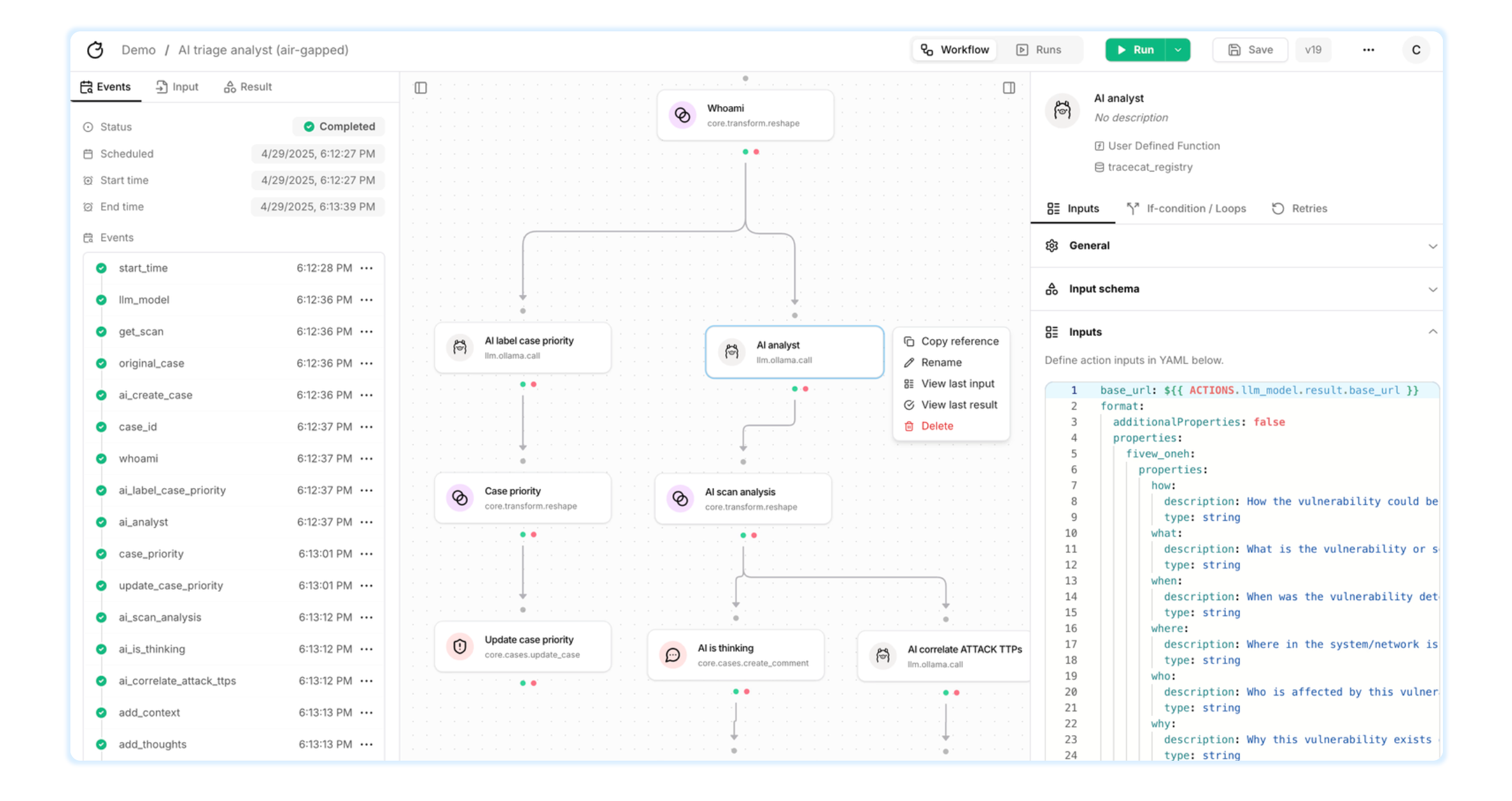
Tracecat is a modern, open source automation platform built for security and IT engineers. It provides an all-in-one solution combining workflows, case management, and lookup tables with no add-ons required. The platform features a no-code click-and-drag workflow builder alongside YAML-based templates for version control and CI/CD integration. Built on Temporal for reliability and scale, Tracecat offers unlimited workflows, over 100+ pre-built integrations, and the ability to create custom integrations via Python and YAML. Founded in 2024 by Y Combinator alumni, Tracecat enables security teams to automate alert triage, enrichment, and response, significantly reducing MTTR (Mean Time To Respond). The platform is cloud-agnostic and can be self-hosted using Docker Compose, Terraform (AWS Fargate), or Kubernetes, giving organizations complete control over their data and infrastructure.
image media

Key Features

AI-Powered Automation

Use specialized AI models to label, summarize, and enrich security alerts automatically, reducing manual triage time.

No-Code Workflow Builder

Click-and-drag interface for building automation workflows without coding required, making it accessible to all skill levels.

Built-in Case Management

Track and manage security incidents all-in-one platform with cases opened directly from workflows for streamlined incident response.

Unlimited Workflows

Create unlimited workflows without licensing restrictions or additional costs, enabling comprehensive automation coverage.

100+ Pre-Built Integrations

Extensive library of integrations with security tools, SIEMs, ticketing systems, and threat intelligence platforms.

Custom Integrations

Create custom integrations using Python and YAML, with Git sync for version control and CI/CD integration.

Pros and Cons

Pros

Open Source with No Vendor Lock-in

Fully open source under AGPL-3.0 license with complete access to source code, enabling customization and preventing vendor lock-in.

Unlimited Workflows

No limits on workflow creation or execution, unlike commercial SOAR platforms that charge per workflow or have usage caps.

AI-Native Platform

Built-in AI capabilities for alert enrichment, summarization, and automated analysis without requiring external AI services.

Self-Hosting Control

Complete control over data and infrastructure with self-hosted deployment options ensuring data sovereignty and security.

All-in-One Solution

Integrated workflows, case management, and lookup tables in a single platform without requiring additional tools or add-ons.

Cons

Platform Still Maturing

Actively developed with potential breaking changes between releases - requires careful release management and testing.

Newer Platform

Founded in 2024, relatively new compared to established SOAR solutions like Splunk, Palo Alto XSOAR, or Tines with years of market presence.

Self-Management Overhead

Free version requires self-hosting and infrastructure management, including updates, scaling, and maintenance responsibilities.

Limited Enterprise Support on Free Tier

Community support only for free self-hosted version - enterprise support requires paid professional or enterprise licenses.

Smaller Ecosystem

Smaller community and ecosystem compared to established vendors, potentially meaning fewer third-party resources and integrations.

Feature Comparison

Comments

No Comments Yet

Be the first to share your experience with Tracecat.

Frequently Asked Questions

Getting Started

OpenMSP is The MSP Knowledge Hub & Community Platform designed specifically for Managed Service Providers seeking to optimize their technology stack, reduce vendor costs, and discover open-source alternatives. We combine a comprehensive vendor directory, open-source solution catalog, and integrated community discussions to help MSPs make informed decisions.
Yes, completely free. Browse vendors and tools, read comparisons, and join community discussions - no cost, no registration required. OpenMSP is community-supported and focused on empowering MSPs to reduce costs and improve operational efficiency through open-source technology.
We help MSPs identify cost-effective alternatives to expensive commercial solutions, provide transparent vendor information, and connect you with proven open-source alternatives. Our platform enables MSPs to make informed decisions about their technology investments.
No account required for browsing vendors, reading comparisons, or accessing community content. Creating a free account with SSO (Microsoft, Google, or Slack) allows you to participate in discussions and save your favorite tools.

Platform Information

OpenMSP is currently community-supported. We focus on providing value to the MSP community first. Any future monetization will keep the core platform free for MSPs while maintaining our independence and commitment to unbiased information.
We focus exclusively on MSP needs with transparent vendor information and open-source alternatives. No vendor partnerships or sponsored listings - just honest, community-driven information to help MSPs make better technology decisions. Our biggest value is our community where MSPs help each other with questions, setup guidance, and sharing real-world experiences.
Our community of MSP professionals helps verify and update information. We also maintain direct research on tools and vendors to ensure accuracy. Community members can report outdated information, and we work to keep everything current.
OpenMSP was founded by Michael Assraf, who has extensive experience in the MSP industry and product leadership. As the former CEO & Founder of Vicarius, Michael grew a startup from $0 to $9M ARR with 500+ customers and deep experience working with MSPs, partners, and fundraising. OpenMSP represents his commitment to empowering the MSP community through better technology decisions and cost optimization.

Open-Source Tools & Alternatives

We assess tools based on active development, community size, documentation quality, production deployments by MSPs, and available support options. Tools must meet strict criteria for reliability and enterprise readiness.
Many open-source projects offer multiple support options including community forums, commercial support from vendors, professional services, and our community discussions where experienced MSPs share implementation guidance.