Splunk Enterprise Security
Security Information and Event Mgmt. (SIEM)
Alternative Vendors


Commercial Alternatives


Key Features
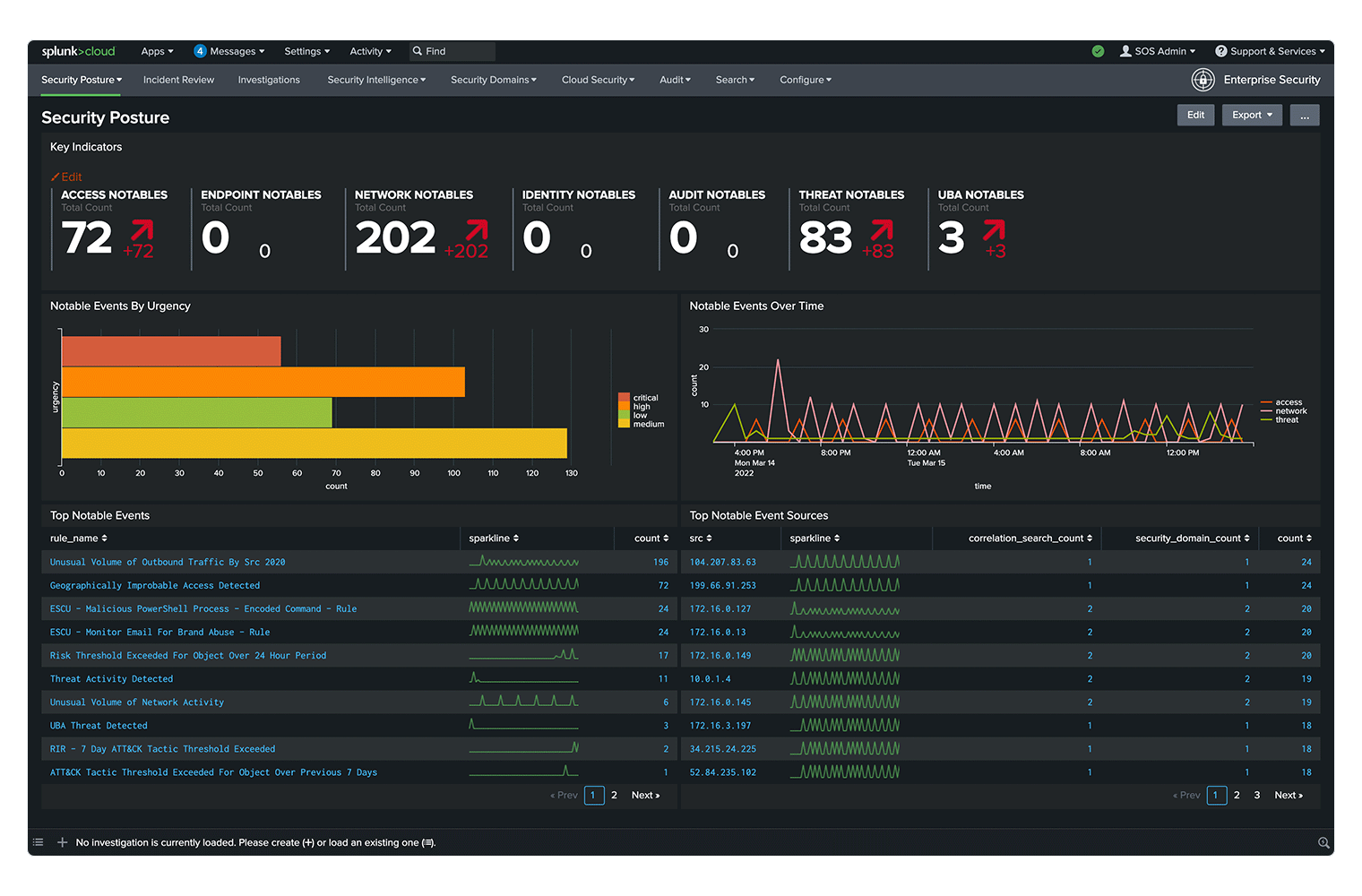
Risk-based alerting
Assigns risk scores to users and assets from many low-level detections and raises findings only when accumulated risk crosses a threshold, which cuts alert volume.
Unified detection, investigation and response
ES 8 brings detections, findings, investigations and response actions into one analyst workspace (the former Mission Control experience).
Detection content mapped to MITRE ATT&CK
Detections from the Splunk Threat Research Team are delivered through ES Content Update and mapped to MITRE ATT&CK so coverage gaps are visible.
Premier edition: native SOAR and UEBA
The Premier edition adds Splunk SOAR playbook automation and user and entity behavior analytics on top of the Essentials SIEM features.
Threat intelligence management
Collects and normalizes threat intelligence feeds and enriches findings automatically, including Cisco Talos intelligence.
Ingest from any source
Uses the Splunk platform to ingest, index and search data from almost any log, metric or API source, with Common Information Model normalization.
Pros and Cons
Pros
Mature detection content
Large, regularly updated detection library from the Splunk Threat Research Team, mapped to MITRE ATT&CK.
Ingests virtually any data
The Splunk platform can index and search almost any log or event source, with field normalization through the Common Information Model.
Risk-based alerting reduces noise
Risk scoring groups many weak signals into fewer, higher-confidence findings for analysts.
Cloud or self-managed
Runs on Splunk Cloud Platform or on self-managed Splunk Enterprise, which suits data residency requirements.
Large app ecosystem
Splunkbase offers many add-ons and apps for third-party data sources and response actions.
Cons
High, quote-based cost
No public price list; licensing is by daily ingest or compute capacity and is typically expensive at scale.
No native MSP multi-tenancy
There is no built-in customer tenancy model; MSSPs separate clients with indexes, roles and apps or run separate deployments.
Steep learning curve
Getting value requires Splunk Search Processing Language (SPL) skills and careful data onboarding.
Heavy self-managed footprint
Self-managed deployments need significant infrastructure and dedicated administrators.
Key features gated by edition
SOAR automation and UEBA are only in the Premier edition.
Feature Comparison
Comments
No reviews yet. Be the first to share your experience with Splunk Enterprise Security.
Frequently Asked Questions
/vendor/splunk-enterprise-security