Breeze logo

Breeze

Remote Monitoring and Management

Open Source
Free Tier
Paid Plans
E
Enterprise
Self-hosted
OpenMSP Score
40
36
Reddit Impact Score
Github Score
159K
46Stars
16Forks
1KCommits
GNU Affero General Public License v3.0License
Jun 21, 2026Last commit
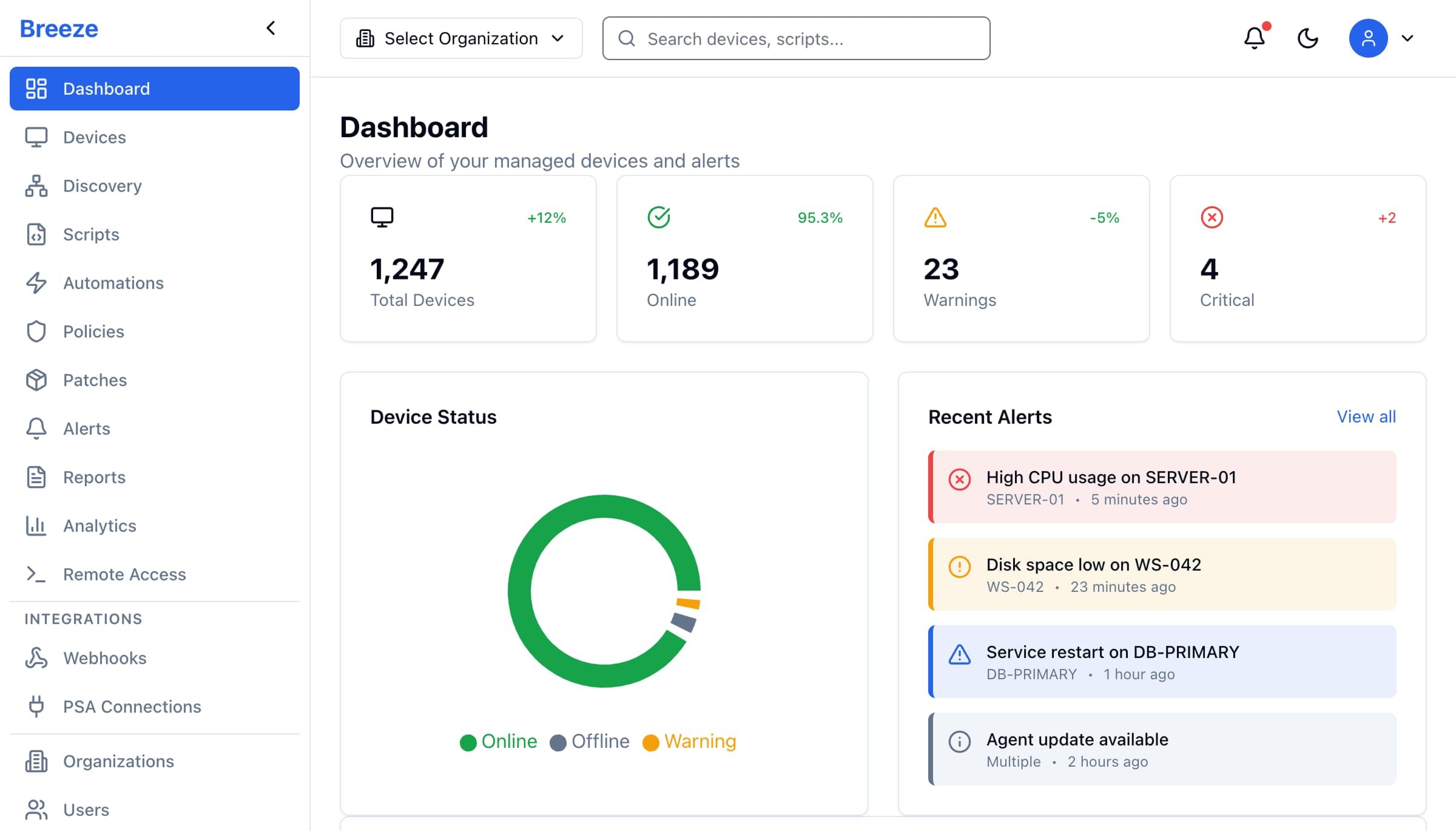
Breeze is an open-source remote monitoring and management platform with AI built into its core. Licensed under AGPL-3.0, it ships 44 modules in every deployment with zero add-ons or per-device fees. The platform's defining feature is its AI brain – a tool-equipped agent (powered by Anthropic's Claude Agent SDK) that investigates alerts, diagnoses root causes, executes remediations, and documents everything automatically. Every AI action passes through a 4-tier risk engine: low-risk actions auto-resolve, medium-risk actions execute with notification, high-risk actions require human approval, and critical actions are blocked entirely. Core capabilities include device management with hardware/software inventory across Windows, macOS, and Linux; remote access via WebRTC (terminal, file browser, remote desktop); patch management with approval workflows; SNMP monitoring; network discovery; configuration policies; automation and scripting (PowerShell, Bash); and alerting with multi-channel routing. Built on a modern stack (Astro + React frontend, Hono TypeScript API, Go agent, PostgreSQL), Breeze is multi-tenant from day one with a Partner → Organization → Site → Device Group → Device hierarchy. The Go-based agent is 15MB – roughly 10–20x smaller than commercial RMM agents. Self-hosted deployment runs via Docker Compose.
image media

Key Features

AI-Native Brain

Built-in AI agent (Anthropic Claude Agent SDK) that investigates alerts, diagnoses root causes, executes remediations, and documents everything. Not a chatbot – a tool-equipped agent with risk-classified guardrails.

Device Management

Hardware and software inventory, real-time health monitoring, configurable policies, and advanced fleet filtering across Windows, macOS, and Linux endpoints.

Remote Access & Control

WebRTC-based remote terminal, file browser, remote desktop, and activity monitoring from a single web interface. No third-party remote access tool required.

Patch Management

Automated OS and application patching with approval workflows, maintenance windows, and compliance reporting.

44 Modules, Zero Add-Ons

Every feature ships in every deployment: SNMP monitoring, network discovery, automations, scripting, DNS security, backup, branding, reports, and more. No per-device fees or feature gating.

Pros and Cons

Pros

AI-Native Architecture

AI agent is core to the platform, not a bolt-on. Investigates, remediates, and documents autonomously with a 4-tier risk engine that enforces guardrails at the RMM level.

No Per-Device Pricing

Free self-hosted with unlimited devices and all 44 modules. No add-on fees, no feature gating, no per-endpoint billing.

Lightweight Agent

15MB Go binary compared to 200-300MB agents from commercial competitors. Cross-platform (Windows, macOS, Linux) with minimal resource footprint.

Modern Tech Stack

Astro + React frontend, Hono TypeScript API, Go agent, PostgreSQL. Clean codebase under active development with 228 commits and 22 releases.

Cons

Very Early Stage

19 GitHub stars, 4 contributors, still at v0.10.x. Pre-1.0 with several features marked as in progress (network discovery, backup). Limited production deployments to reference.

No PSA Integration Yet

ConnectWise, Autotask, and HaloPSA integrations are on the "Later" roadmap. MSPs who need PSA connectivity today will need to wait or build custom API bridges.

Small Community

Discord community is nascent. Limited third-party tutorials, community scripts, or battle-tested deployment guides compared to TacticalRMM or commercial alternatives.

Cloud Hosting Not Yet Available

Self-hosted only. Managed cloud is on a waitlist with no confirmed launch date. MSPs without Docker/Linux skills face a higher barrier to entry.

Feature Comparison

Comments

No Comments Yet

Be the first to share your experience with Breeze.

Frequently Asked Questions

Getting Started

OpenMSP is The MSP Knowledge Hub & Community Platform designed specifically for Managed Service Providers seeking to optimize their technology stack, reduce vendor costs, and discover open-source alternatives. We combine a comprehensive vendor directory, open-source solution catalog, and integrated community discussions to help MSPs make informed decisions.
Yes, completely free. Browse vendors and tools, read comparisons, and join community discussions - no cost, no registration required. OpenMSP is community-supported and focused on empowering MSPs to reduce costs and improve operational efficiency through open-source technology.
We help MSPs identify cost-effective alternatives to expensive commercial solutions, provide transparent vendor information, and connect you with proven open-source alternatives. Our platform enables MSPs to make informed decisions about their technology investments.
No account required for browsing vendors, reading comparisons, or accessing community content. Creating a free account with SSO (Microsoft, Google, or Slack) allows you to participate in discussions and save your favorite tools.

Platform Information

OpenMSP is currently community-supported. We focus on providing value to the MSP community first. Any future monetization will keep the core platform free for MSPs while maintaining our independence and commitment to unbiased information.
We focus exclusively on MSP needs with transparent vendor information and open-source alternatives. No vendor partnerships or sponsored listings - just honest, community-driven information to help MSPs make better technology decisions. Our biggest value is our community where MSPs help each other with questions, setup guidance, and sharing real-world experiences.
Our community of MSP professionals helps verify and update information. We also maintain direct research on tools and vendors to ensure accuracy. Community members can report outdated information, and we work to keep everything current.
OpenMSP was founded by Michael Assraf, who has extensive experience in the MSP industry and product leadership. As the former CEO & Founder of Vicarius, Michael grew a startup from $0 to $9M ARR with 500+ customers and deep experience working with MSPs, partners, and fundraising. OpenMSP represents his commitment to empowering the MSP community through better technology decisions and cost optimization.

Open-Source Tools & Alternatives

We assess tools based on active development, community size, documentation quality, production deployments by MSPs, and available support options. Tools must meet strict criteria for reliability and enterprise readiness.
Many open-source projects offer multiple support options including community forums, commercial support from vendors, professional services, and our community discussions where experienced MSPs share implementation guidance.