OpenFrame Gen1 is Here

SOCFortress WAF Platform logo

SOCFortress WAF Platform

Network Management and Monitoring

Commercial Vendor
E
Enterprise
OpenMSP Score
0
N/A
Reddit Impact Score
Github Score
0
6Stars
1Forks
6Commits
Custom EULA (source-available, not OSI-approved)License
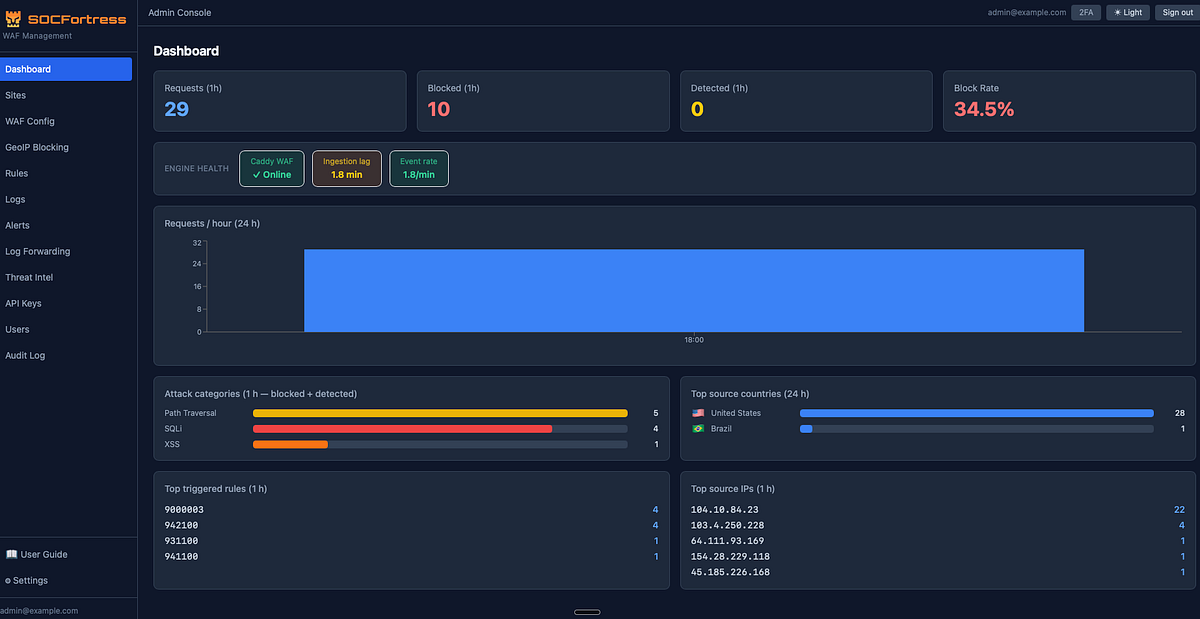
SOCFortress WAF Management Platform is a self-hosted web application firewall management system built by SOCFortress, a company otherwise known for open-source SOC/SIEM tooling built around Wazuh. Rather than writing a new WAF engine, the platform orchestrates existing open-source components: Caddy acts as the reverse proxy/TLS terminator in front of protected applications, and Coraza (a Go-based, ModSecurity-compatible WAF engine) inspects traffic using the OWASP Core Rule Set v4 to detect and block SQL injection, XSS, path traversal, and similar attacks. Around this, SOCFortress adds a FastAPI backend, PostgreSQL database, Redis cache, and a React dashboard so administrators can manage multiple protected sites, toggle detection-only vs. blocking mode, tune/exclude CRS rules to cut false positives, view GeoIP-enriched request/block logs, and configure email/Slack/webhook alerting. The stack deploys via Docker Compose using prebuilt container images - no source build required. Despite being publicly viewable on GitHub, the code is distributed under a proprietary End User License Agreement rather than an OSI-approved open-source license, and it is a very early-stage project (single-digit GitHub stars and commits at time of listing).
image media

Key Features

Coraza + OWASP CRS v4 Engine

Blocks common web attacks (SQLi, XSS, path traversal) using an industry-standard rule set.

Detection vs. Blocking Mode

Per-site toggle allows safe rollout by monitoring before enforcing.

Rule Tuning & Exclusions

Granular per-parameter false-positive exclusions without editing raw config files.

Multi-Site Management

Protect several upstream applications from one platform instance.

GeoIP-Enriched Logging

PostgreSQL-backed, searchable request/block logs with country-based blocking via MaxMind GeoLite2.

TOTP 2FA & RBAC

Two-factor authentication plus role-based access control for the admin dashboard.

Pros and Cons

Pros

Built on Proven Open Components

Coraza, Caddy, and OWASP CRS are established, actively maintained open-source projects, not a proprietary engine.

Fast Deployment

Docker Compose stack claims a ~10-minute setup with prebuilt images.

Central Management UI

Replaces manual Coraza config editing with a web dashboard, rule tuning, and log search.

Low Resource Footprint

Documented minimum of 2GB RAM, suitable for small MSP/SMB deployments.

Backed by an Established SOC Vendor

SOCFortress has existing credibility in the open-source SOC/SIEM space via its Wazuh ecosystem.

Cons

No Visible Track Record

No case studies, customer references, or independent reviews found; unproven at scale.

Not Actually Open Source

Public on GitHub but distributed under a proprietary End User License Agreement, not an OSI-approved license.

Very Early-Stage/Niche Project

Only 6 GitHub stars, 1 fork, and ~6 commits, with no formal releases at time of listing.

Minimal Community/Documentation

No wiki or topics/tags; documentation limited to the README with unclear long-term roadmap.

Single-Vendor Lock-In for Support

Commercial/enterprise support is only available directly through SOCFortress, with no public pricing disclosed.

Feature Comparison

Comments

No Comments Yet

Be the first to share your experience with SOCFortress WAF Platform.

Frequently Asked Questions

Getting Started

OpenMSP is The MSP Knowledge Hub & Community Platform designed specifically for Managed Service Providers seeking to optimize their technology stack, reduce vendor costs, and discover open-source alternatives. We combine a comprehensive vendor directory, open-source solution catalog, and integrated community discussions to help MSPs make informed decisions.
Yes, completely free. Browse vendors and tools, read comparisons, and join community discussions - no cost, no registration required. OpenMSP is community-supported and focused on empowering MSPs to reduce costs and improve operational efficiency through open-source technology.
We help MSPs identify cost-effective alternatives to expensive commercial solutions, provide transparent vendor information, and connect you with proven open-source alternatives. Our platform enables MSPs to make informed decisions about their technology investments.
No account required for browsing vendors, reading comparisons, or accessing community content. Creating a free account with SSO (Microsoft, Google, or Slack) allows you to participate in discussions and save your favorite tools.

Platform Information

OpenMSP is currently community-supported. We focus on providing value to the MSP community first. Any future monetization will keep the core platform free for MSPs while maintaining our independence and commitment to unbiased information.
We focus exclusively on MSP needs with transparent vendor information and open-source alternatives. No vendor partnerships or sponsored listings - just honest, community-driven information to help MSPs make better technology decisions. Our biggest value is our community where MSPs help each other with questions, setup guidance, and sharing real-world experiences.
Our community of MSP professionals helps verify and update information. We also maintain direct research on tools and vendors to ensure accuracy. Community members can report outdated information, and we work to keep everything current.
OpenMSP was founded by Michael Assraf, who has extensive experience in the MSP industry and product leadership. As the former CEO & Founder of Vicarius, Michael grew a startup from $0 to $9M ARR with 500+ customers and deep experience working with MSPs, partners, and fundraising. OpenMSP represents his commitment to empowering the MSP community through better technology decisions and cost optimization.

Open-Source Tools & Alternatives

We assess tools based on active development, community size, documentation quality, production deployments by MSPs, and available support options. Tools must meet strict criteria for reliability and enterprise readiness.
Many open-source projects offer multiple support options including community forums, commercial support from vendors, professional services, and our community discussions where experienced MSPs share implementation guidance.