OpenFrame KM logo

OpenFrame KM

Documentation and Password Management

OpenFrame Selected
Open Source
Free Tier
Self-hosted
OpenMSP Score
19
6
Reddit Impact Score
Github Score
366K
60Stars
18Forks
3KCommits
OtherLicense
Jul 11, 2026Last commit
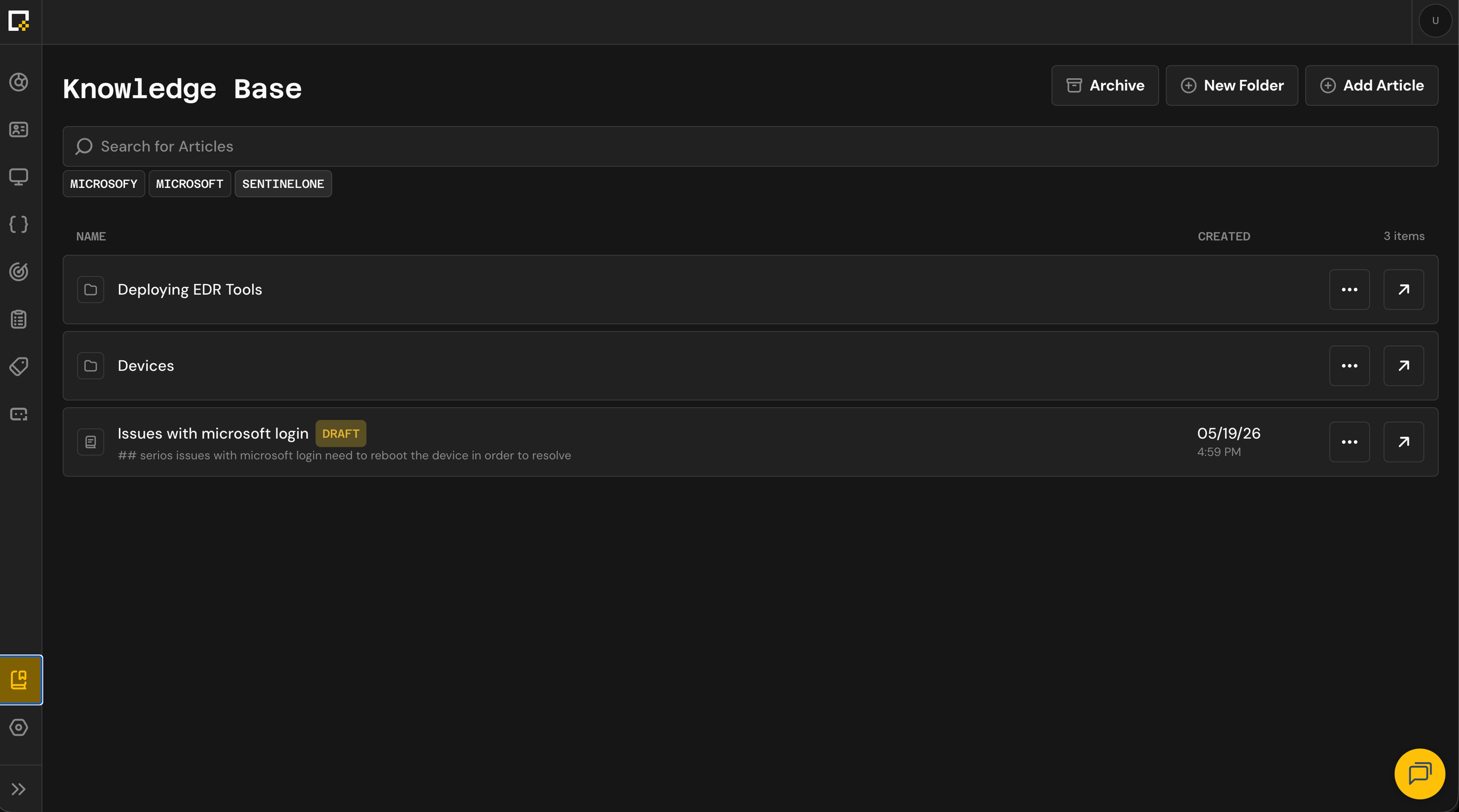
OpenFrame KM is the knowledge management module of the OpenFrame platform - one home for documentation, runbooks, SOPs, and network configuration docs. Launched in OpenFrame v0.8.15, it gives MSPs version-controlled documentation repositories, searchable knowledge bases, automated doc generation from device and system configurations, and collaborative editing. All inside the same platform that handles RMM, PSA, and remote access. The knowledge base is wired into Mingo, OpenFrame's technician-facing AI assistant. Since v0.9.19, Mingo can search knowledge base articles, retrieve them by ID, and create new articles straight from a chat prompt. v0.9.52 added one-click AI drafting for docs and runbooks, @-mentions that attach knowledge articles to chats for context, and related articles surfaced right on device detail pages. Like the rest of OpenFrame, KM is open source and self-hosted, with no per-technician licensing. Documentation lives next to tickets, devices, and scripts instead of in a separate tool, so runbooks stay current and techs don't tab out to find answers.
image media
1 / 2

Key Features

Version-Controlled Documentation

Documentation repositories with version control for runbooks, SOPs, and network configuration docs

Searchable Knowledge Base

Centralized, searchable knowledge base unified with tickets, devices, and scripts in one platform

Mingo AI Knowledge Tools

Search, retrieve, and create knowledge base articles directly from a Mingo chat prompt

AI-Generated Docs & Runbooks

One-click "Generate with AI" drafting for docs and runbooks, with @-mention article context in chat

Automated Doc Generation

Automatically generate documentation from device and system configurations

Collaborative Editing

Collaborative editing with a publishing workflow and per-article access control

Pros and Cons

Pros

Unified With RMM and PSA

Documentation lives next to tickets, devices, and scripts in one platform - no separate documentation tool or per-seat license needed

AI-Powered Documentation

Mingo AI can search, retrieve, and create knowledge base articles from a chat prompt, plus one-click AI drafting of docs and runbooks

Zero Per-Technician Fees

Open source and free to self-host with no per-seat licensing, unlike IT Glue or Hudu per-user pricing

Version-Controlled Repositories

Documentation repositories with version control keep runbooks, SOPs, and network configuration docs auditable and current

Automated Doc Generation

Generates documentation automatically from device and system configurations, reducing manual documentation debt

Cons

Young Product

Launched in OpenFrame v0.8.15 (May 2026) and still in beta - less mature than established documentation platforms like IT Glue or Hudu

Not a Standalone Tool

Requires the OpenFrame platform - not deployable as an independent documentation product

No Built-In Password Management

Focused on documentation and runbooks; MSPs needing credential vaulting still need a dedicated password manager

Self-Hosting Requires Expertise

Self-hosted deployments require infrastructure knowledge and maintenance (mitigated by the managed cloud option)

Feature Comparison

Comments

No Comments Yet

Be the first to share your experience with OpenFrame KM.

Frequently Asked Questions

Getting Started

OpenMSP is The MSP Knowledge Hub & Community Platform designed specifically for Managed Service Providers seeking to optimize their technology stack, reduce vendor costs, and discover open-source alternatives. We combine a comprehensive vendor directory, open-source solution catalog, and integrated community discussions to help MSPs make informed decisions.
Yes, completely free. Browse vendors and tools, read comparisons, and join community discussions - no cost, no registration required. OpenMSP is community-supported and focused on empowering MSPs to reduce costs and improve operational efficiency through open-source technology.
We help MSPs identify cost-effective alternatives to expensive commercial solutions, provide transparent vendor information, and connect you with proven open-source alternatives. Our platform enables MSPs to make informed decisions about their technology investments.
No account required for browsing vendors, reading comparisons, or accessing community content. Creating a free account with SSO (Microsoft, Google, or Slack) allows you to participate in discussions and save your favorite tools.

Platform Information

OpenMSP is currently community-supported. We focus on providing value to the MSP community first. Any future monetization will keep the core platform free for MSPs while maintaining our independence and commitment to unbiased information.
We focus exclusively on MSP needs with transparent vendor information and open-source alternatives. No vendor partnerships or sponsored listings - just honest, community-driven information to help MSPs make better technology decisions. Our biggest value is our community where MSPs help each other with questions, setup guidance, and sharing real-world experiences.
Our community of MSP professionals helps verify and update information. We also maintain direct research on tools and vendors to ensure accuracy. Community members can report outdated information, and we work to keep everything current.
OpenMSP was founded by Michael Assraf, who has extensive experience in the MSP industry and product leadership. As the former CEO & Founder of Vicarius, Michael grew a startup from $0 to $9M ARR with 500+ customers and deep experience working with MSPs, partners, and fundraising. OpenMSP represents his commitment to empowering the MSP community through better technology decisions and cost optimization.

Open-Source Tools & Alternatives

We assess tools based on active development, community size, documentation quality, production deployments by MSPs, and available support options. Tools must meet strict criteria for reliability and enterprise readiness.
Many open-source projects offer multiple support options including community forums, commercial support from vendors, professional services, and our community discussions where experienced MSPs share implementation guidance.