How One IT Pro Built a Free, Open-Source ITSM Platform at His Kitchen Table

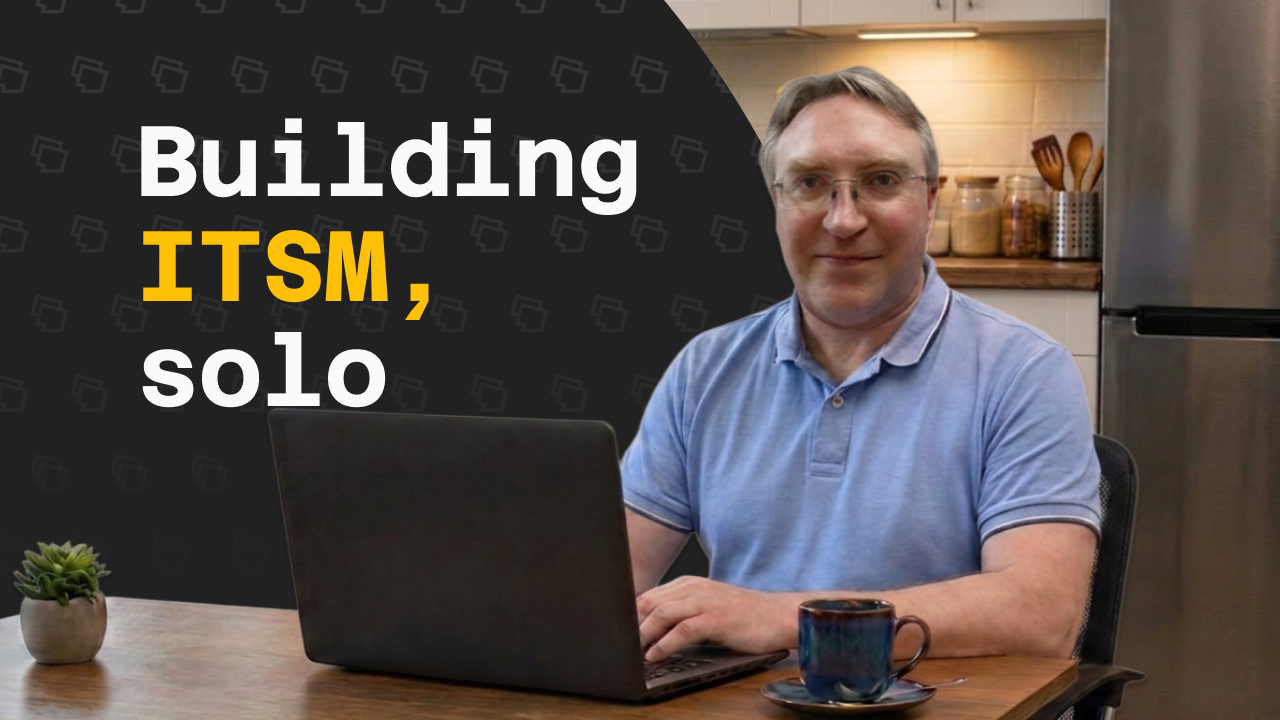
How Ed Mozley built FreeITSM, a free 20-module open-source ITSM platform, solo at his kitchen table, and why it stays free for good.
Updated: July 2026
Ed Mozley wanted a ticketing system he actually liked. He couldn't find one, so he built it himself, on nights and weekends, at his kitchen table. A few months later he had a 20-module open-source ITSM platform, and he gave it away for free.
Ed isn't a Silicon Valley founder or a full-time developer. By day he runs infrastructure and applications for a city law firm in London. The whole thing started this past February with one small experiment and a tool that's quietly changing what a single practitioner can build.
The short version
- What it is: FreeITSM, an open-source IT service management platform with 20 modules.
- Who built it: Ed Mozley, a London-based IT manager, working solo.
- How long: Started in February 2026 and grew module by module from there.
- The price: Free, under an MIT license, with no paid tier planned.
- Where to hear the story: Episode 2 of the OpenMSP Podcast.
One mailbox, then twenty modules
Ed spent the first half of his IT career on service desks, which is where he got to know more than a few awkward ticketing tools. He'd also tinkered with code as a hobby for years without ever calling himself a developer. What changed this year was vibe coding: using AI assistants wired deep into a development environment to write and iterate on software through plain-language prompts.
So one evening he sat down at his kitchen table and tried to solve a single problem, connecting to an Exchange mailbox. It worked almost on the first try. He jumped up to tell his wife he'd connected to a mailbox, and she wasn't entirely sure why he was so excited. That was the spark.
From there it grew, one idea at a time. Ed describes adding modules the way most people add things to a shopping list. He'd be on the train to work and decide that tonight he'd build a CMDB. He'd pop to the corner shop for a pint of milk and come home ready to add a knowledge base. Today FreeITSM spans twenty modules, including ticketing, a CMDB, a knowledge base, business-process mapping, and an AI layer wired up through OpenRouter.
Free for good, and he means it
The detail that stops people is the price. FreeITSM is free. Not free-for-now, not free-with-an-upgrade. Free on purpose, released under the most permissive license Ed could find (MIT), with no paid tier in the works.
Ask him why, and the answer is refreshingly honest: he says he hasn't got a commercial bone in his body. The moment he started charging, he'd take on obligations he doesn't want, the kind that come with ISO 27001, ISO 9001, ISO 42001, formal contracts, and a steady queue of bug reports. He'd rather skip all of that and let the work be useful. He's even said he'd be glad if people copied it outright.
He's also clear that he isn't trying to run a company on the side. He told his boss about the project with a friendly "don't panic," and asked that the firm not adopt it, simply because he didn't want to become its product manager on top of his actual job. The goal was never a business. It was to build something good and put it where anyone could use it.
A small story with a big signal
It's tempting to file this under "nice side project" and move on. The more interesting read is what it says about where IT tooling is heading.
For a long time, the cost and complexity of building this kind of software was the moat. An ITSM platform meant a team, a roadmap, and a budget. When one practitioner can stand up a credible open-source ITSM platform on evenings and weekends, that barrier starts to look a lot smaller, and the people who actually use these tools get more say in how they work.
On the podcast, OpenMSP's Michael Assraf framed it as a broader shift: as AI and open source make the underlying tool layer cheaper to build and run, the value moves up the stack. The advantage stops being whether you can afford the same platform as a 500-person enterprise, and starts being what you build on top of it, your processes, your response times, your client relationships. For MSPs and IT teams keeping an eye on budgets, that's an opening, not a threat.
What's next for FreeITSM
Ed isn't slowing down. Near the top of his list is an MCP layer, so you could talk to FreeITSM from tools like Teams or Claude. He's also planning to make it multi-tenant and to add a proper API, which he describes as something close to a moral imperative: open source with a closed-source mindset, no API, isn't where he wants to be.
It's spreading on its own, too. Ed cheerfully admits he's terrible at marketing, with a core following of maybe forty or fifty people who check in regularly. And yet someone in the IT department of a hotel chain in Indonesia is already running his software, which delights him to no end.
His advice, if you're sitting on an idea
Ed's takeaway for anyone thinking about building something is simple: go for it. Ignore the people who tell you it's already been done or that you won't pull it off. Treat failure as a step, not a verdict. Do your homework on the basics, keep your security tidy (don't leave API keys in your GitHub repo), and then enjoy the process.
That spirit runs through the whole conversation. You don't need funding, a team, or a computer science degree to build something people will actually use. You need to understand the problem, and you need to start.
Hear Ed Mozley tell the full story on Episode 2 of the OpenMSP Podcast (listen here). FreeITSM is on GitHub, free for anyone who wants it.

Content Marketing Lead
Ohayo! I run content, SEO, social, and community at Flamingo. Before IT, I worked as a correspondent for Ukraine's Public Broadcasting Company and have a Master's in journalism.